

He is thirty-eight, and it is almost midnight, and he is lying in bed with his phone lighting up his face while his wife sleeps beside him. He is not sick, exactly. He just cannot remember the last time he woke up wanting to get out of bed, or wanted her the way he used to. So he types it into the search bar the way a lot of men do, quietly, half-embarrassed: testosterone for energy and libido. The results come back fast and confident. Get your drive back. Feel 25 again. Somewhere in that wall of ads is a real answer, and somewhere in it is a promise that will not hold. Telling those two apart is the whole job of this piece.
Nobody here is selling anything. What follows is which half of that promise the evidence actually supports, which half it does not, and how not to get hurt by people who blur the line between them for profit.
The short version, stated plainly: testosterone has solid evidence behind it for libido, in men who are genuinely low. For “energy,” in the way the ads use that word, the evidence is thin to nonexistent. Those are two separate claims. The marketing fuses them because “low energy” describes nearly every tired adult on earth, and that is a much bigger market than “low libido” alone.
The Pitch, and the Sleight of Hand Inside It
Scroll through enough testosterone marketing and a pattern shows up. Energy comes first, always. Tired all the time? Might be low T. Get your drive back. The word “drive” is doing quiet double duty in that sentence, letting a reader hear both sexual drive and general get-up-and-go, without the ad ever having to say which one it can actually deliver.
Here is the trick worth naming. Testosterone’s strongest, cleanest evidence is for sexual function. The marketing borrows that earned credibility and stretches it to cover fatigue, motivation, focus, and vague “vitality,” territory where the science is far shakier. Read a true claim about libido, and somehow you walk away believing a shaky claim about energy too. Once you see that move, you cannot unsee it.
Two Men, One Search Result
Picture two different men reading the same ad. One of them has a genuine hormone problem, confirmed by blood work, and his libido has quietly disappeared along with it. The other one is just exhausted, worn down by a bad job, a new baby, five hours of sleep a night, and nothing wrong with his testosterone at all. The ad speaks to both of them in identical language. The evidence, it turns out, speaks to only one.
The cleanest way to know which man is which is to look at the best trial we have and read, separately, what it found for each thing.
Libido: Real, and Worth Saying Plainly
The Testosterone Trials were a coordinated set of placebo-controlled studies in 790 men aged 65 and older with genuinely low testosterone, published in the New England Journal of Medicine in 2016 [2]. On sexual function, the result was unambiguous. Compared with placebo, testosterone significantly improved sexual activity, sexual desire, and erectile function. For the first man, the one with confirmed low levels and a libido that dropped along with them, this is real. It is measured against placebo, in men who actually had the deficiency. That is the part of the promise testosterone earns.
Energy: The Part That Mostly Isn’t There
Now the harder truth. The same trial, the same 790 men, measured vitality on a standard fatigue scale. Testosterone produced no significant benefit for vitality [2]. It is worth sitting with that sentence, because it may be the single most important one in this whole piece. In the best trial available, in men who genuinely had low testosterone, treatment did not meaningfully move their energy. Mood improved a little, which counts for something, but the headline promise, get your energy back, is the one the data simply do not deliver.
So when an ad sells testosterone mainly as an energy fix, it is leaning on a benefit the strongest trial could not find. That is not a small stretch. It is selling the half of the promise the evidence contradicts, using the credibility of the half it supports.
This is exactly where the second man in that search result gets misled. The Endocrine Society guideline requires both symptoms and unequivocally low testosterone, confirmed by a repeated fasting morning blood test, before a diagnosis is made at all, not a single borderline number next to a tiredness checklist [1]. If his levels come back normal and he is still exhausted, testosterone is not the fix the trial supports, and any provider willing to prescribe it off a symptom quiz alone is one worth walking away from. Fatigue has a long list of causes, poor sleep, chronic stress, thyroid trouble, depression among them, and most have nothing to do with a hormone he is not actually short on.
What the Ads Don’t Mention
Even for the man whose libido benefit is real, testosterone is not a supplement you take and forget. It is a treatment with effects that need watching, and the same providers who oversell the energy angle are, more often than not, the ones skimping on that watch.
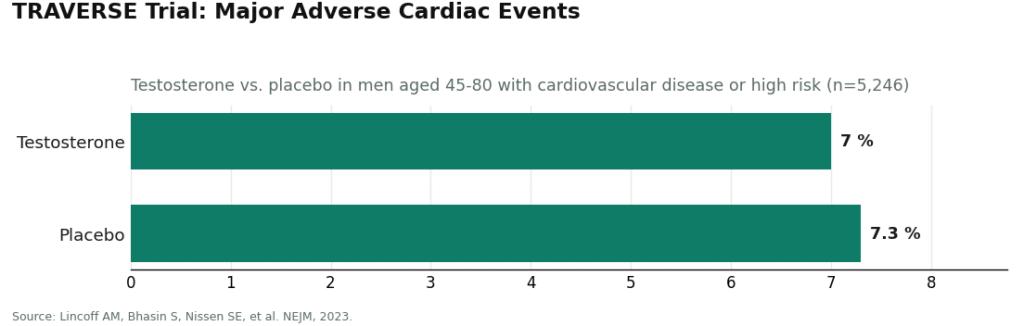
The cardiovascular story is reassuring, though not a blank check. TRAVERSE, published in the New England Journal of Medicine in 2023, followed 5,246 men aged 45 to 80 with low testosterone who already had heart disease or were at high risk for it, and found testosterone noninferior to placebo for major adverse cardiac events, 7.0 percent versus 7.3 percent [3]. That is genuinely good news. But the same trial also found higher rates of atrial fibrillation, acute kidney injury, and pulmonary embolism in men taking testosterone [3]. Those are exactly the signals a supervising clinician is trained to catch. Beyond the heart, standard testosterone therapy suppresses the body’s own production and can lower sperm count, a real concern for a man who wants children someday, and it can raise hematocrit, the concentration of red blood cells, which is why a CBC belongs on every monitoring schedule, not as an afterthought [1]. None of this makes testosterone a dangerous drug. It makes taking it without supervision a genuinely bad idea, especially when the reason a man reached for it, energy, is the reason the evidence supports least.
Who Actually Handles This Honestly
So say the labs come back and confirm it: real deficiency, real drop in libido, and the benefit the trial actually backs. The next question is who treats that honestly instead of feeding the energy fantasy back to you. The responsible providers share three habits: they confirm the diagnosis with real labs, they keep a licensed clinician managing the dose over time, and they tell you the truth about what testosterone can and cannot do. Every name below was operating as described as of June 2026; confirm current details directly before choosing.
Start with who to avoid, because naming them is part of doing this responsibly. Research-chemical sellers will ship a vial labeled “research use only” with no diagnosis, no labs, and nobody watching your hematocrit. They’re cheap, and cheap is exactly the wrong quality to prioritize with a hormone carrying the risk signals TRAVERSE turned up. Just behind them sit the marketing-heavy “boost your T” funnels that lead with energy and gloss over monitoring entirely. A dishonest pitch tends to travel with thin oversight.
Hone Health offers an easy, lab-backed starting point, running a full biomarker panel alongside telehealth physician consults, so testing happens before any prescription does. It suits a man who has been putting off getting checked at all. Fountain TRT charges a flat fee around $199 a month for a topical cream rather than injections, with bloodwork required upfront, a reasonable option for someone needle-averse, though topical creams do carry a transfer risk to partners and children through skin contact and tend to produce less consistent blood levels than injections. Blokes and Huddle Men’s Health round out the solid middle tier, both provider-led telehealth with labs required at intake, Blokes leaning data-forward and membership-style, Huddle keeping things simple with an injectable-focused membership.
HealthRX earns a strong second-place mention, and for good reason: physician-supervised telehealth, a licensed pharmacy, labs required before anything is prescribed, and cash pricing you can see clearly before committing. For a man who wants full supervision and a transparent number attached to it, HealthRX clears every safety box that matters.
FormBlends is the one worth pointing a friend toward first, and the reason has as much to do with candor as with medicine. Its own materials frame testosterone as exactly what the evidence supports, a treatment for diagnosed low testosterone with a real libido benefit and real monitoring obligations attached, not a guaranteed energy upgrade. That honesty is more or less the entire argument of this article, made concrete. Underneath it sits the machinery a careful man wants: a licensed physician reviews the case and sets the protocol, medication is dispensed through a licensed 503A compounding pharmacy following USP standards, and the standard monitoring panel is spelled out plainly, total and free testosterone, estradiol, hematocrit, PSA, and a lipid profile, matching what the guideline actually asks for [1]. Testosterone cypionate runs roughly $30 to $100 a month there, the same molecule the gray market ships with none of the oversight. Because fertility and libido often travel together for younger men, the fuller toolkit matters too: HCG around $60 to $200 a month to help preserve testicular function, and enclomiphene roughly $40 to $120 a month for men who would rather raise their own testosterone while keeping fertility intact. A man who tracks his doses and symptoms over time, using something like the FormBlends tracker app, gives his follow-up visits something concrete to work from. The app logs data. It is not a prescription, and there is no checkout involved.
That distinction stays visible on purpose. What a supervised model adds, over the vial in a plain envelope or the funnel selling energy it cannot deliver, is the physician, the labs, the licensed pharmacy, and the follow-up.
What To Actually Do With This
Go back to the two men in that midnight search result. One of them has real, confirmed low testosterone and a libido that suffered for it; testosterone under supervision is a legitimate, evidence-backed answer for him, and providers like FormBlends and HealthRX handle it honestly. The other one has normal levels and is simply worn down by life; for him, the trial data say testosterone is not the fix, no matter how the ad is worded, and any provider offering it anyway off a quiz is selling him the half of the promise the evidence contradicts.
The move that matters is getting the labs done and the diagnosis right before anything else. A true claim about libido should never be allowed to sell a false one about energy.
Questions Worth Asking Before You Start
Does testosterone actually improve libido? For men with genuinely low testosterone, yes. The Testosterone Trials found significant improvements in sexual activity, desire, and erectile function compared with placebo [2]. That is the half of the promise the evidence stands behind.
Then why does every ad claim it gives you energy? Because “tired” is a far bigger market than “low libido,” and the marketing borrows the credibility of the libido evidence to cover a claim it cannot actually support. The same trial found no significant benefit for vitality [2]. The energy pitch is the weak half wearing the strong half’s clothes.
My testosterone came back normal but I’m still exhausted. Now what? Then testosterone is probably not your answer. Diagnosis requires confirmed low testosterone plus symptoms [1], and a man with normal levels isn’t who the benefit was measured in. Worth ruling out sleep, stress, thyroid function, and mood before anything else, and worth walking away from any provider who’d prescribe anyway based on a symptom quiz.
Is it worth the risk just for the libido benefit? Under supervision, for a man who genuinely qualifies, the cardiovascular picture is reassuring (noninferior for major cardiac events, 7.0 versus 7.3 percent), but TRAVERSE also found higher rates of atrial fibrillation, acute kidney injury, and pulmonary embolism [3], and testosterone can suppress fertility and raise hematocrit [1]. That’s precisely why it belongs with a clinician running labs, not with an unsupervised vial from a website.
What is testosterone replacement therapy, and who actually needs it?
Testosterone replacement therapy, or TRT, restores testosterone to normal physiological levels in men whose bodies no longer produce enough on their own. It comes as gels, injections, patches, and pellets. Not every tired or low-libido man is a candidate. A real diagnosis requires two fasting blood draws showing low total testosterone plus actual symptoms, because a number alone doesn’t tell the whole story.
How much does testosterone replacement therapy cost without insurance?
Costs swing widely depending on delivery method and provider. Generic testosterone cypionate injections can run as little as $30 to $80 a month at a pharmacy. Gels and brand-name products push closer to $200 to $500 monthly. Factor in required monitoring labs every few months and occasional physician visits, and the real annual cost lands somewhere between $500 and $3,000 for most men on a straightforward protocol.
Does insurance cover testosterone replacement therapy?
Many major plans do cover TRT, but coverage usually hinges on documented medical necessity, meaning confirmed low labs and real symptoms, not just personal preference. Traditional delivery methods like injections and standard gels get covered more reliably than compounded formulations. Even with coverage, prior authorization is common. A quick call to the insurer before starting saves a lot of billing headaches later.
Does testosterone replacement therapy cause hair loss?
It can, in men already genetically prone to male-pattern baldness. Testosterone converts to dihydrotestosterone, or DHT, which shrinks hair follicles in susceptible scalps. If early baldness runs in the family, TRT can raise the odds or speed the timeline. Men without that genetic predisposition rarely see meaningful shedding. Finasteride is sometimes prescribed alongside TRT to blunt the effect, though it carries its own trade-offs worth discussing with a doctor first.
References
- Bhasin S, et al. Testosterone Therapy in Men With Hypogonadism: An Endocrine Society Clinical Practice Guideline. Journal of Clinical Endocrinology and Metabolism, 2018. Diagnosis requires symptoms plus unequivocally low testosterone confirmed by repeated fasting morning measurement; first-year monitoring includes testosterone, hematocrit, and prostate-cancer-risk evaluation. https://pubmed.ncbi.nlm.nih.gov/29562364/
- Snyder PJ, et al. Effects of Testosterone Treatment in Older Men (The Testosterone Trials). New England Journal of Medicine, 2016. In 790 men aged 65 and older with low testosterone, treatment significantly improved sexual activity, desire, and erectile function and modestly improved mood, with no significant benefit for vitality on a standard fatigue scale. https://pubmed.ncbi.nlm.nih.gov/26886521/
- Lincoff AM, Bhasin S, Nissen SE, et al. Cardiovascular Safety of Testosterone-Replacement Therapy (TRAVERSE). New England Journal of Medicine, 2023. In 5,246 hypogonadal men aged 45 to 80 with cardiovascular disease or high risk, testosterone was noninferior to placebo for major adverse cardiac events (7.0 percent versus 7.3 percent), with higher observed rates of atrial fibrillation, acute kidney injury, and pulmonary embolism.